Student-Led Report Calls for Overhaul of Campus Responses to Sexual Violence
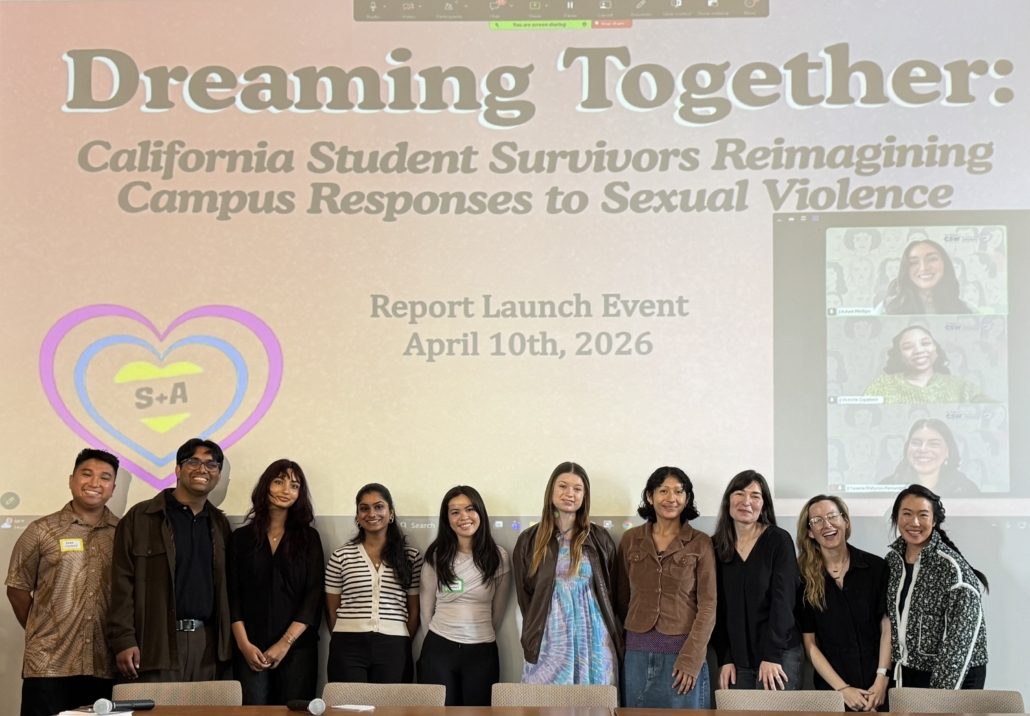
“Dreaming Together: California Student Survivors Reimagining Campus Responses to Sexual Violence,” report launch event April 10th, 2026.
A new report from Survivors + Allies, a student advocacy group within the Center for the Study of Women|Streisand Center, presents a sweeping analysis of how colleges across California respond to sexual violence and where those systems fall short. Drawing on data from more than 1,600 students, Dreaming Together: California Student Survivors Reimagining Campus Responses to Sexual Violence outlines urgent reforms centered on survivor care, equity, and accountability.
Over the past year, Survivors + Allies conducted a mixed-methods, student-led research study spanning campuses across California, including the University of California (UC), California State University (CSU), community colleges, and private institutions. The study centers the lived experiences of student survivors of sexual violence and harassment (SVSH), with a focus on understanding what enables and prevents suvivor healing.
Drawing on a dataset of 1,649 survey respondents and 20 in-depth survivor interviews conducted between May 2025 and February 2026, the report offers a comprehensive student-driven analysis of campus SVSH responses in the state.
Key Findings
- Mandatory SVSH Trainings Fall Short: Students report that required campus training is often ineffective, failing to meaningfully address survivor needs or prevent harm.
- Marginalized Students Face Heightened Risk: Universities are not adequately ensuring safety for students who experience intersecting forms of marginalization, including race, gender identity, sexuality, and disability.
- Introducing the “Survivors’ Calculus”: S+A introduces a new framework, the Survivors’ Calculus, which exposes the hidden labor survivors must undertake to assess whether seeking support is worth the emotional, academic, and social costs.
- Survivors Prefer Confidential, Survivor-Centered Care: Participants emphasized the importance of accessible, confidential resources that prioritize survivor autonomy over institutional liability.
Research Approach
The study used an anonymous survey distributed through student organizations, social media, and campus partnerships, alongside paid outreach. It included both quantitative and open-ended questions. Interviews provided deeper insight into survivors’ healing journeys and their navigation of campus systems.
Quotes from survivors are included throughout: “I was told (I can’t remember by who) that without much proof, they wouldn’t be able to do much”, one student reported. Another said, “[I couldn’t reach out to campus resources] because this situation happened off campus.”
Survivors were defined as students who reported experiencing unwanted sexual contact or harassment at any point in their lives, whether they responded “yes” or “maybe/unsure.”
From Research to Policy: The HEAR Survivors Act
The report arrives at a pivotal moment, coinciding with S+A’s co-sponsorship of AB 2212, the Higher Education AI Response (HEAR) Survivors Act. Introduced in partnership with Rebecca Bauer-Kahan, the bill addresses the growing threat of technology-facilitated sexual harm on college campuses.
Key provisions of AB 2212 include:
- Expanding definitions of sexual harassment to include AI-generated explicit content, deepfakes, and sextortion
- Requiring colleges and universities to prohibit nonconsensual digital sexual material
- Mandating updated education and prevention training
- Strengthening reporting mechanisms and survivor support systems
The bill has already passed through the Assembly Privacy and Consumer Protection Committee on Consent. Survivors + Allies’ first report From Surviving to Healing: Results and Demands from a Study with Survivors of Sexual Violence on University of California Campuses informed over 11 bills signed into law, demonstrating the tangible policy impact of student-led research and advocacy.
As campuses continue to grapple with both longstanding and emerging forms of harm, this report offers a roadmap shaped by those most directly impacted.
Read the full report: Dreaming Together: California Student Survivors Reimagining Campus Responses to Sexual Violence
Watch the report launch: Dreaming Together Report Launch
Follow for updates: Follow Survivors + Allies on Instagram