Our letter to Cornell and What the Dreaming Together Report Offers
The letter shares findings from Dreaming Together, a student-led study of California campus responses to sexual violence.
Content note: This post discusses sexual violence and campus reporting systems. Support resources are listed at the end.
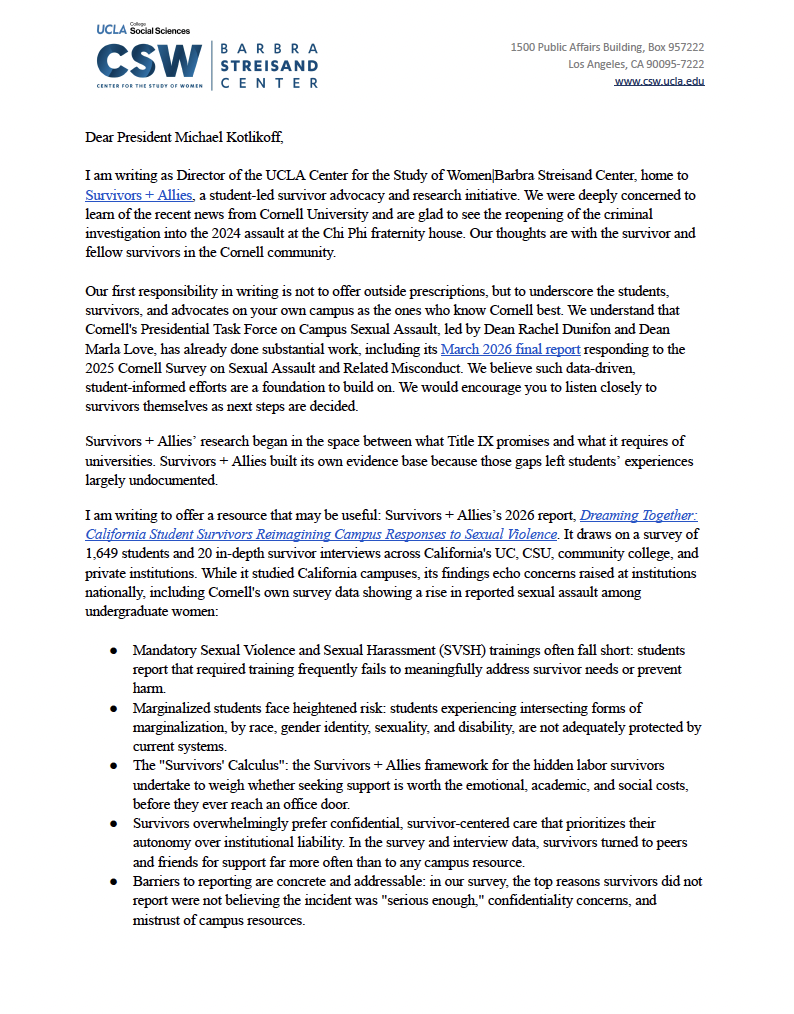
After consulting with student advocacy researchers, UCLA Center for the Study of Women|Barbra Streisand Center sent a letter to Cornell University President Michael Kotlikoff and members of Cornell’s leadership and Presidential Task Force on Campus Sexual Assault. The letter responds to recent news from Cornell and offers research from Survivors + Allies, the student-led survivor advocacy and research initiative based at CSW|Streisand Center, as a resource for Cornell as it decides on next steps.
Cornell’s students, survivors, and advocates know their campus best, and CSW|Streisand Center encourages university leaders to listen closely to them.
Student Advocacy
Survivors + Allies began its research in the gap between what Title IX promises and what it requires of universities. Because that gap left students’ experiences largely undocumented, student researchers built their own evidence base. Their 2026 report, Dreaming Together: California Student Survivors Reimagining Campus Responses to Sexual Violence, draws on a survey of 1,649 students and 20 in-depth survivor interviews across California’s UC, CSU, community college, and private institutions.
The letter highlights the report’s “Survivors’ Calculus,” a framework for the hidden labor survivors undertake to weigh whether seeking support is worth the emotional, academic, and social costs before they ever reach an office door. It shifts the question from “why don’t students use our resources?” to “what is the resource actually costing the student to access, and does that cost make sense given what they’re likely to get back?”
The survey data reflect that calculation. Among survivors who did not report:
- 49% said the incident “wasn’t serious enough” to warrant it
- 32% cited confidentiality concerns
- 18% cited mistrust of campus resources
Peer networks were the primary source of support: among survivors who reached out to anyone, almost half turned to a peer or friend, on or off campus.
Other findings in the report include that mandatory sexual violence and sexual harassment trainings often fall short of addressing survivor needs, that students facing intersecting forms of marginalization are not adequately protected by current systems, and that survivors overwhelmingly prefer confidential, survivor-centered care that prioritizes their autonomy over institutional liability.
Read more
- Read the letter to Cornell leadership (PDF)
- Read Dreaming Together: California Student Survivors Reimagining Campus Responses to Sexual Violence
- Learn more about Survivors + Allies
- “UCLA student groups call for more survivor resources, Title IX reforms across UC” (Daily Bruin)
Support resources
If you or someone you know has been affected by sexual violence, confidential support is available. UCLA students can reach the CARE Advocacy Office at advocate@careprogram.ucla.edu or by calling (310) 206-2465. Contact RAINN’s National Sexual Assault Hotline 24/7 to connect with a real, live person who’s trained to help; call 800.656.HOPE or text HOPE to 64673.