Call for Proposals: Thinking Gender 2027
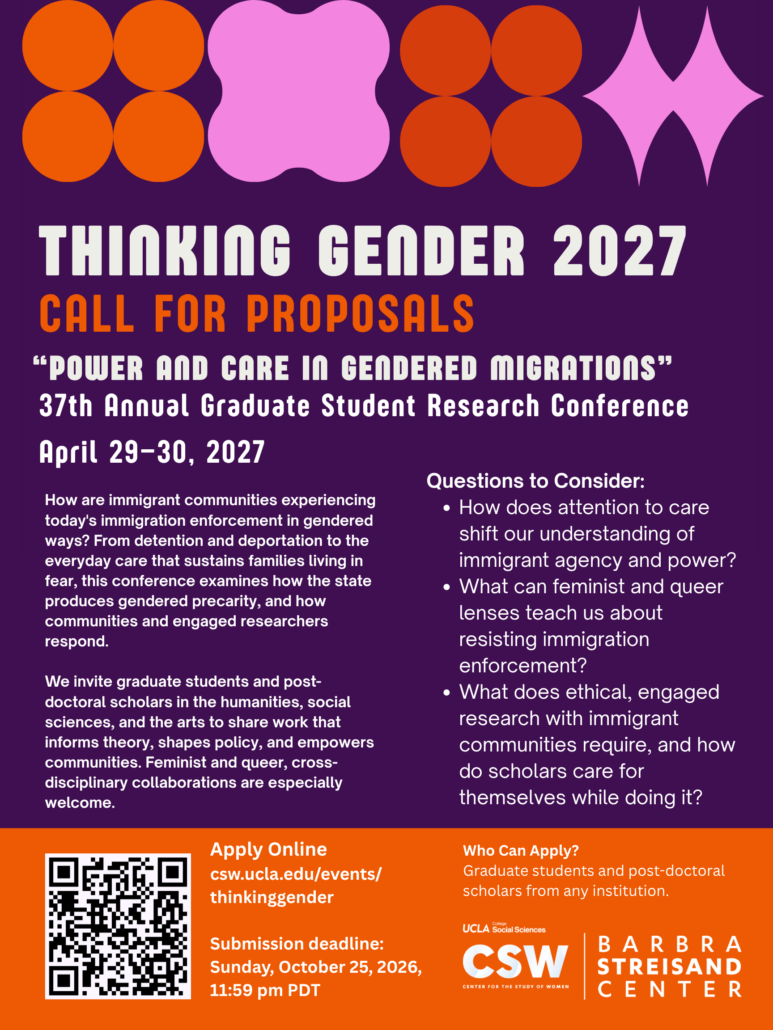
Thinking Gender 2027
“Power and Care in Gendered Migrations”
April 29–30, 2027
Call for Proposals
Submission deadline: Sunday, October 25, 2026, 11:59 pm PDT
The UCLA Center for the Study of Women|Barbra Streisand Center invites proposals for our 37th annual Thinking Gender Graduate Student Research Conference (TG27). Proposals from post-doctoral scholars are also welcome.
This year’s conference theme, “Power and Care in Gendered Migrations,” explores how immigrant communities are experiencing the fast-paced changes and highly visible implementation of immigration policies in gendered ways. From direct impacts like detention and deportation to practices of care for families and communities living in fear, the conference considers how the state produces gendered precarity and insecurity for immigrant communities. It simultaneously considers the role and practices of engaged researchers who accompany immigrants during tumultuous political moments.
Migration processes around the world are deeply shaped by and constitutive of race and gender. Migrants cross borders, access jobs, earn wages, remain in contact with relatives, settle into communities in different ways along raced and gendered pathways. Immigration laws, in particular, can transform gender relations, producing gendered risks, opportunities, norms, and expectations. These may also vary by race, sexuality, religion, and disability. In recent years, immigration law enforcement in the United States has played out dramatically, leading to record numbers of detentions, tragic family separations, and sustained state terror. Meanwhile, in Europe, EU immigration policies have made of the Mediterranean Sea an open mass grave, offering confinement and only bare life to refugees forced into camps. In the United States, while Mexican and Central American immigrants have been the most common targets, immigrants from the Caribbean, Africa, South America, Asia, and other parts of the world have also been detained and harmed. Across the world, racialized people are similarly targeted. As scholars conduct engaged research with immigrant communities, they have the potential to document not just the unstable political landscape, but also the gendered notions behind policies, as well as the gendered consequences and responses in this moment. In the face of devastating enforcement practices, changing policies, and widespread fear, how are immigrants, their families, and communities responding?
And as engaged scholars, how are researchers showing up, holding the dignity of migrants centrally in their work while continuing to theorize new forms of violence? How should the practice of research and writing adapt to make it possible for academics to do their work in such trying times? How are researchers caring for the communities they write about while also caring for themselves and each other?
Understanding gendered migrations through a research ethic of care requires multidisciplinary tools to perceive the power of the state, as well as the power of the people targeted by the state. It calls for analytical lenses that recognize the complex humanity of those who are too often erased in the oft-cited statistics and heavy-handed stereotypes of hegemonic state narratives. We invite applications from graduate students and post-doctoral scholars in the humanities, social sciences, and the arts who want to produce work that can inform theory, shape policy, and empower communities. Feminist and queer collaborations across disciplines are welcomed. We want the conference to be a supportive, generative, and collaborative space where we value ethical research methods, expansive ways of knowing, and creative forms of data-driven storytelling.
Possible questions for engagement include, but are not limited to:
- How are immigrant communities experiencing the present moment of immigration law enforcement in gendered ways?
- What are the unique harms produced through immigration policies of the 21st century?
- How do immigrants envision their future in new countries where the government may be portraying them as the enemy?
- What is the role of state and local governments in relation to federal enforcement policies, and how do immigrants understand these multilevel legal practices and different modes of care that they may call for?
- How might immigration policies be newly envisioned through feminist and queer lenses?
- How does attention to care shift our perspectives on immigrant agency and power along gendered lines?
- How have feminist and queer theories contributed to understandings of gendered immigration law enforcement?
- What are instances of political care work inspired amid harsh immigration enforcement?
- How does attention to feminist and queer relationality teach us about resistance to immigration enforcement?
- How are immigration enforcement and its consequences connected to health, including reproductive justice?
- How can immigration rights work be guided by feminist and queer ways of knowing?
- How have access to, data about, or the governance of, immigration been shaped by relations of power, including gender, sexuality, sex, indigeneity, race, disability, and class?
- What forms of care come into view through the study of feminist and queer mobilities across borders?
- Why and how is migration gendered? How has a rise in detentions been stratified?
- How does immigration policy and enforcement shape gendered family dynamics, including for children of immigrants?
- How does immigration enforcement shape children of immigrants’ educational trajectories in gendered ways?
- Which research methods are called for in studying immigrant communities in this moment, and how are they attentive to gender?
- In what ways have US foreign policy interventions and immigration policies differentially affected marginalized communities?
- What forms of organizing are called for, toward feminist and queer responses to violent immigration law enforcement?
- How are scholars grounding themselves to conduct engaged work with immigrant communities during times of political instability?
- What does writing about contemporary political violence require of us to document and how should we best disseminate our findings?
- What are best practices for ethical research with immigrant communities?
- How can scholars practice care with immigrant communities and with themselves as knowledge producers during times of crisis?
The in-person conference will take place Thursday–Friday, April 29–30, 2027. In addition, accepted students are required to participate in three online co-writing sessions in the months leading up to the conference (see dates below).
Conference elements:
- Online co-writing sessions for works-in-progress over the course of 3 virtual meetings between January and March 2027
A cohort of 12 participants will participate in three virtual gatherings to discuss their process and work on their works-in-progress in closed online sessions between January and March 2027. This collaborative approach aims to open space for honest conversations about the emotional toll of doing ethical engaged research with immigrant communities during this political moment and to support participants in moving their works-in-progress forward. The co-writing sessions are only open to students whose works-in-progress submissions have been accepted for the conference workshops. Attendance is required. Co-writing session dates: January 14, 2027; February 11, 2027; and March 11, 2027, 9:00–10:30 am PST. - In-person workshops for works-in-progress on Thursday, April 29, 2027
Participants will workshop their works-in-progress in closed in-person workshops at the UCLA campus. This conference day is closed to the public. Each workshop will feature up to four graduate students/post-doctoral scholars and a faculty moderator. The participants and the moderator in each workshop will be asked to carefully read or view the submissions for their workshop in advance, and to prepare thoughtful questions and constructive comments. Moderators will facilitate discussion around each submission. Participants are expected to attend all three workshops (not just their own) and to have read the works of participants in the other workshops so that they can contribute to the discussion in a meaningful way. Work-in-progress will be shared with all one month before the conference. - In-person symposium on Friday, April 30, 2027
This conference day is open to the public and will include a keynote address and conversation, workshops, and networking opportunities. A more detailed program will be shared closer to the conference.
We welcome a range of submission formats from graduate and post-doctoral scholars, including scholarly papers, works in hybrid critical/creative genres (e.g., multimedia projects, performance, experimental forms of academic writing), place-based engagements, and film/mixed media.
Submission Guidelines
Eligibility
Registered graduate students and post-doctoral scholars from any institution are eligible to submit abstracts or synopses of scholarly papers, works in hybrid critical/creative genres (e.g., multimedia projects, performance, experimental forms of academic writing), place-based engagements, and film/mixed media to workshop. Applicants may not submit multiple proposals.
Note that 12 applications will be accepted, at least eight from graduate students, and up to four from post-doctoral scholars.
Please only submit if you are available for the full day as all participants are required to support and engage with all works-in-progress in the three workshops.
Submissions of works that are collaborative or co-authored with other students are welcome.
Unpublished submissions are preferred. Recently published and forthcoming articles will be considered on a case-by-case basis. Submissions that are not directly related to the theme, “Power and Care in Gendered Migrations,” will not be considered.
Due date for submissions: Sunday, October 25, 2026, at 11:59 pm PDT.
Applicants whose submissions are accepted will be notified in mid-December 2026.
Note that admitted applicants will be required to submit the final version of their work-in-progress (not to exceed 20–25 double-spaced pages) by Monday, March 15, 2027, for pre-circulation among participants and faculty moderators.
Application Materials
All proposals must be submitted using the online application form.
Only complete submissions received by the due date will be considered.
Please submit as a Word doc, not PDF or other formats.
Scholarly Paper, Dissertation or Thesis Chapter, or Article Draft Application Requirements:
- Abstract (max. 250 words) of work to be workshopped that includes: (1) a thesis/research question, (2) methods, (3) theoretical framework, and (4) conclusions or anticipated conclusions.
- Works Cited or References List (1 page maximum)
- CV (2 pages maximum)
Film/Mixed Media or Hybrid Critical/Creative Genres Application Requirements:
- Film/Media Synopsis (2 double-spaced pages maximum) of work to be workshopped that includes: (1) a research question or thesis, (2) description of format, (3) discussion of theoretical framework, methodology and process, (4) explanation of your argument and evidence, and (5) conclusions or anticipated conclusions. If your piece is co-created with other students, please make this clear.
- CV (2 pages maximum)
- Link (YouTube, Vimeo, etc.) where film or mixed media can be viewed. Total run-time should not exceed 20 minutes. Note: our submission platform does not support uploaded files. Please insert links into your synopsis.
For applications in other genres, please contact us for requirement details at the email below.
Questions? Contact CSW|Streisand Center at thinkinggender@women.ucla.edu.