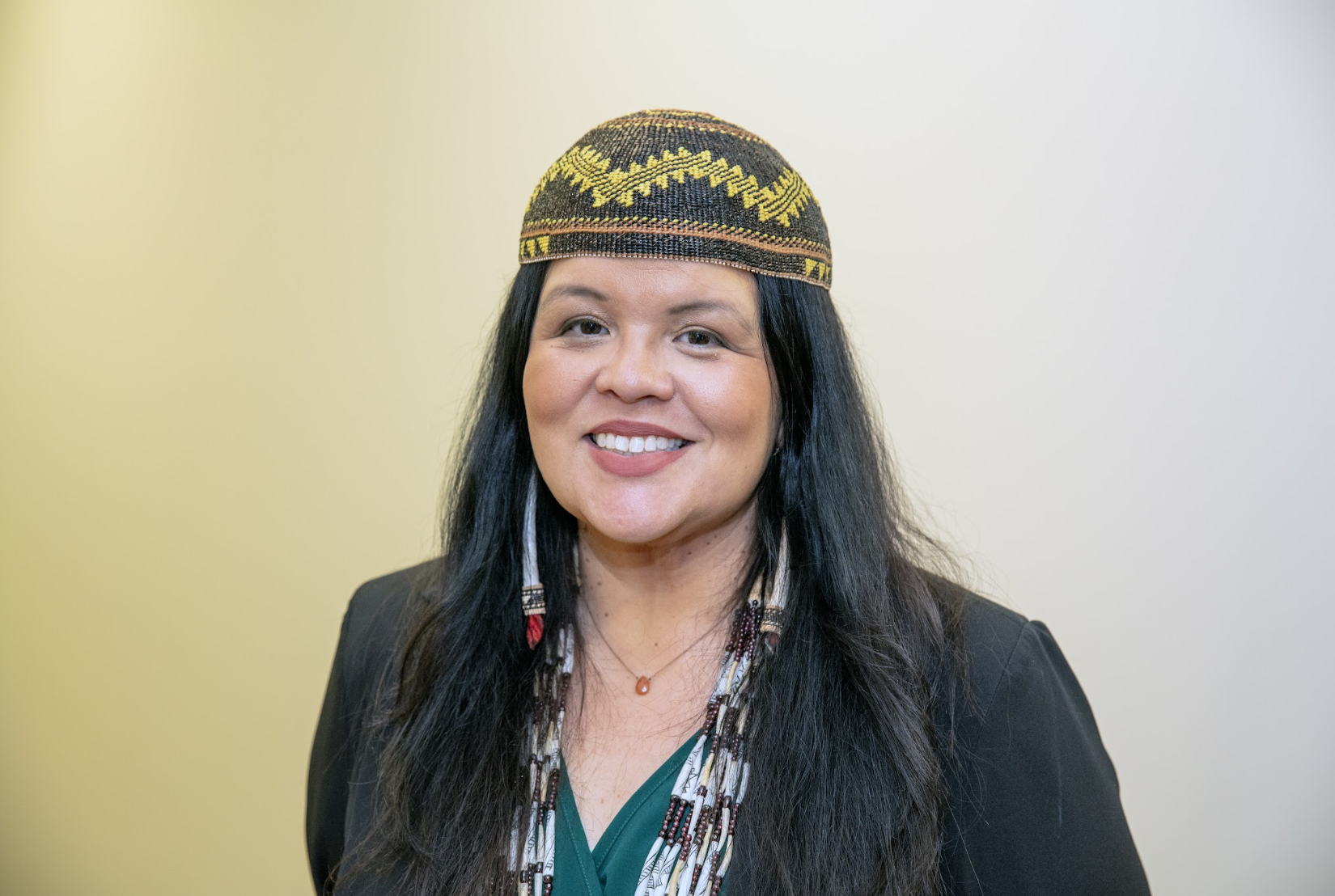
Thinking Gender 2026 Keynote Spotlight: Dr. Cutcha Risling Baldy
By Tavi Carpenter, Coordinator, Thinking Gender 2026 Conference
I first had the opportunity to meet Dr. Cutcha Risling Baldy (Hupa, Karuk, Yurok) when I interviewed her and two of her graduate students for News From Native California. I had the great pleasure of learning about the incredible work being done at the Rou Dalagurr Food Sovereignty Lab and Traditional Ecological Knowledges Institute at Cal Poly Humboldt, as well as its inspiring story of coming to be. The concepts for this space were formed when Risling Baldy asked her class to use their group projects to create something lasting that was community oriented. Since those early days, the lab and TEK institute have continued to grow, and created a truly unique and necessary space dedicated to the empowerment of community by centering indigenous knowledge systems and ways. In 2025, Risling Baldy and her co-director Dr. Kaitlin Reed were awarded the James Irvine Foundation Leadership Award, including a $350,000 grant, in recognition of the contributions the Rou Dalagurr Lab & TEK Institute is making in addressing critical issues California is facing by centering and creating space for indigenous sciences and community-grounded work. I highly recommend learning more about the incredible work they are doing at this nationally recognized center by visiting their website, as well as watching this welcome video.
Dr. Risling Baldy is an impressive person with a wealth of knowledge that seemingly pours out of her in conversation. If I’m being honest, I was a little intimidated to interview her at first, but that all dissipated as the interview progressed. By the end of our meeting, her care for her community work, her scholarship, and the students she mentors was extremely motivating for me as a recent admit to graduate school at UCLA.
In American Indian studies, Dr. Risling Baldy is one of the leading voices on radical relationality, ecofeminism, cultural revitalization, and Indigenous feminism. I first had the pleasure of learning about her work when I read her article, “Why we gather: traditional gathering in native Northwest California and the future of bio-cultural sovereignty” (2013). Her explanation and analysis of TEK and land management policies has had a great impact on me, as I begin specifying my current research on land stewardship, collaboration, and co-management agreements in Northern California.
In 2018, Dr. Risling Baldy published her critically acclaimed book, We Are Dancing for You: Native Feminisms and the Revitalization of Women’s Coming-of-Age Ceremonies and won the 2019 “Best First Book” Award from the Native American and Indigenous Studies Association. Now, a seminal book within Indigenous and feminist studies, We Are Dancing for You is a powerful read. Focusing on the revitalization of cultural practices with the Hoopa Valley Tribe, Risling Baldy centers the resiliency of California Indigenous people, our knowledge systems, and the continued survivance in the face of colonization, as well as the important role Native feminism has as an epistemological foundation necessary for decolonial praxis. Risling Baldy highlights a fundamental premise in the preface, “The social-spiritual enactment of these practices was responsible for keeping the earth in balance and society thriving” (2018). This sentence makes explicit a fundamental truth that I was taught by my elders: when our home is healthy, we are healthy; we are not disconnected from one another; there is a relationship that, as we continue to see with greater clarity, we all need to work on collectively. How we continue to strengthen and rebuild these relationships within the contemporary moment is filled with challenges. Yet the path forward begins with discourse and thoughtful scholarly work thinking about how to address these challenges.
This is why it is so exciting to introduce Dr. Cutcha Risling Baldy as this year’s 2026 Thinking Gender Graduate Student Conference keynote speaker. Her talk, “Indigenous Women Know How to Save the World: Framing a California Indigenous Ecofeminist Ethic,” is certain to be generative for us all as we consider this moment in history, and the important role feminist and queer ecologies play within it.
In anticipation of the conference in April, CSW|Streisand Center has explored this year’s conference theme, “Feminist and Queer Ecologies,” in a variety of ways. In February, we held a screening of Fire Tender by directors Roni Jo Draper (Yurok) and Marissa Lila that was exceptionally well attended. We are so grateful to all who were able to turn out and for the wonderful conversation about cultural burnings, the relationship with fire in California, land stewardship, and climate resiliency. We would also like to give a shout out to the Fire Kinship: Southern California Native Ecology and Art exhibition at the Fowler Museum on the UCLA Campus. The exhibition will close on April 12, 2026. It is certainly worth seeing for anyone interested in this year’s Thinking Gender theme, and it ties in nicely with our screening of Fire Tender.
We hope you will be able to join us on Friday, April 17, 2026, for exciting panels with our graduate student presenters and Dr. Cutcha Risling Baldy’s keynote address! It will be a vibrant day filled with incredible people, voices, thoughts, and community.
For more information and to register to the conference.
Tavi Lorelle Carpenter is a second year PhD Student in the Anthropology Department at UCLA. Her research focuses on tribal sovereignty, governance, indigeneity, co-management agreements, land management & stewardship in Northern California. She is a Coast Miwok, Dry Creek Pomo, Southern Pomo, and Mishewal Wappo lineal descendant.