Reflecting on “Feminist & Queer Ecologies”: A Mood Board, A Legacy, and A Call to Relationality
By Tavi Lorelle Carpenter (Coast Miwok, Dry Creek Pomo, Southern Pomo, Mishewal Wappo)
This year, the Thinking Gender Conference, hosted by the Center for the Study of Women|Barbra Streisand Center, will mark its 36th year. Since its inception in 1991, Thinking Gender has offered a space for emerging scholars enrolled in graduate programs to share their groundbreaking research. It is genuinely an honor to be part of this continuing legacy, given this year’s theme of “Feminist & Queer Ecologies.”
This theme feels exceptionally relevant, not just for me personally, but for all of us during this time of uncertainty. We are in a moment when the path forward cannot continue under a model of extraction and exploitation. An ethic of relationality is necessary, as it always has been. As scholars and intellectuals, it is feminist and queer theoretical frameworks that are leading the way.
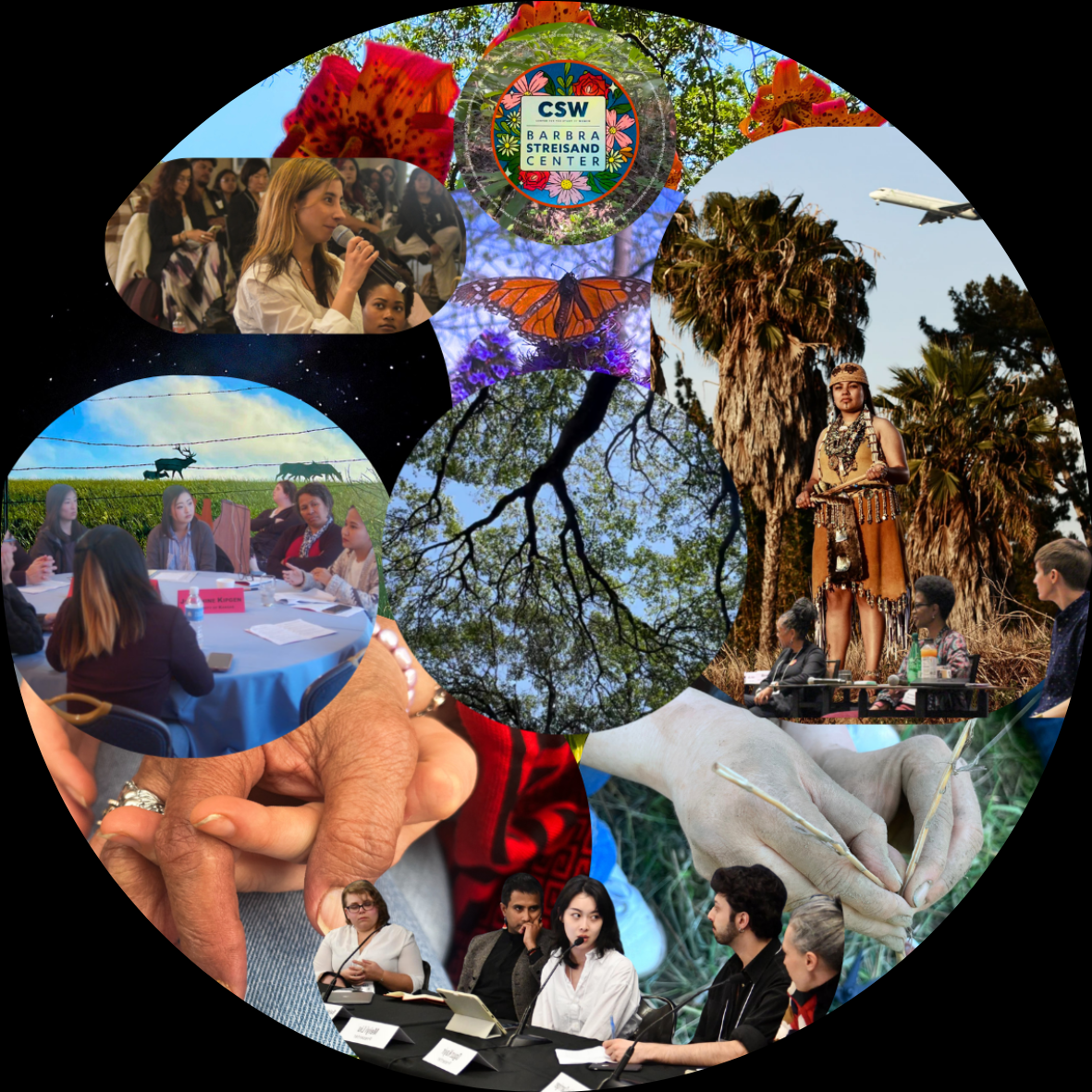
When I started my position as the Thinking Gender coordinator, I was asked to put together a mood board of how this year’s theme spoke to me and what I hoped for the conference. For this first blog post, I have been asked to share that very collage. While the collage has a lot going on, I will focus on four main photos.
In the center of the collage is an image from my fieldwork this past summer. It is a Black Oak tree; as an elder tree, its vast branches stretching overhead allowed for the ecosystem underneath it to thrive exponentially. Underneath the canopy of the oak tree, it was 10 degrees cooler, a reprieve from the hot July day. I struggle to put into words what it was like to look up and see her leaves dancing in the wind. Perhaps it was gratitude, but it was also a lesson in the interdependence we have with one another and our more-than-human kin. So much life in this little ecosystem, going about its day, each with its own life cycles. Some living very long, such as the oak tree, others only here for a season, offering a lesson in understanding the balance between collectivity and independence.
On the bottom left of the circle, you will see two pairs of hands (my grandmother’s and mine) loosely interlaced. This photo was taken during a visit to Point Reyes, part of our ancestral homelands. My Grandmother is one of the most important people in my life; her strength, resilience, and ethic of care are center points that provide grounding in my academic journey. My Grandmother is who I learned about relationality from in the deepest sense. As a little girl, my Grandma moved onto the historic Graton Rancheria, 15.45 acres of land set aside by the federal government for landless California Indian people. When the California Rancheria Termination Act of 1958 was passed, it greatly impacted all California Indian people, continuing the colonial legacy of land dispossession. My grandmother, in her strength and resilience, was able to protect and hold on to the last remaining acre that she continues to live on. Her strength inspires me to continue her legacy of caring for our people and our home. The need for intergenerational exchange is a necessary part of maintaining our right to responsibility. It is our elders who act as a bridge to our ancestors, and the youth who act as a bridge to the future.
Directly opposite our interlaced hands is a photo of my hands covered in a thin layer of dirt from digging sedge. I am splitting the sedge root and processing it so it can be used for baskets. This day was an opportunity given to me by one of our cultural bearers, who is always so generous and kind in her sharing of knowledge. As is true for Indigenous people around the world, the colonial project puts significant effort into the dispossession of Indigenous people from their homelands. This is not only done through physical violence, but also through psychological and spiritual violence. But I believe that connection cannot be forcibly taken away, in spite of everything, we are still here and we still fight for our right to responsibility[1].
The last element I wish to draw your attention to is on the right-hand side of the circle above the image of me splitting sedge. It is an incredible photograph taken by California Indian artist Cara Romero (Chemehuevi). It is called Miztla at Puvunga, part of a series “created for #TONGVALAND-a-site-specific installation” featuring Mitzlayolxochitl Aguilera (Tongva/Gabrielino). I first saw this photograph at the Oxy Arts exhibit[2], “The Irredescence of Knowing,” curated by Joel Garcia (Huichol) and Mercedes Dorame (Tongva), centering Southern California Indian artists. In a description of the piece, Cara Romero states:
“This is a tragic story of not having ceremonial grounds to gather in privacy and without the permission of state and private landowners. As Native people, we understand that Mother Earth must hear her languages, songs and dance that emerge from place and cultures to be in balance.”
It would be impossible to have any conversation about feminist and queer ecologies without finding a way to express gratitude to the Tongva people and to Tovaangar. I am not sure words are ever enough, but I will say it in my language, Walli Ka Molis.
This also offers a moment to note the importance in being a good guest and how we can use this traditional value, deeply steeped in California Indian epistemologies and ontologies, to think about a decolonial future.
There is always so much more to say, to think, to do—but for now, as the fall quarter comes to a close, it is almost time to take a beat. Let us continue these discussions in 2026, and especially at the Thinking Gender conference in the spring.
[1] The right to responsibility is a concept within Indigenous ontologies stemming back to time immemorial. It highlights the importance of being in good relations with land and waterways, expressed through reciprocity that requires tending and caring for our homelands.
[2] “The Iridescence of Knowing” Exhibit Weaves Together Southern California Native Artists and the Intergenerational Knowing of Home by Tavi Lorelle Carpenter 9/15/2023
Thank you to the CSW|Streisand Center, Katja Antoine, Rosa Chung, Jessica Cattelino, Rosemary Grant and Eva Amarillas Diaz, and all of the student workers. It is such a pleasure to work with all of you.
I also would like to give so much love and gratitude to Robin Meely and Joseph Byron for the generosity they have always shown me in sharing our cultural ways and our language.
Lastly, I express my love and gratitude to my family, especially my Grandmother Gloria Armstrong.
Thank you so much to Cara Romero for giving your permission to use this photo as part of this collage. I am so incredibly grateful, and I want to encourage all the readers to visit her website: