
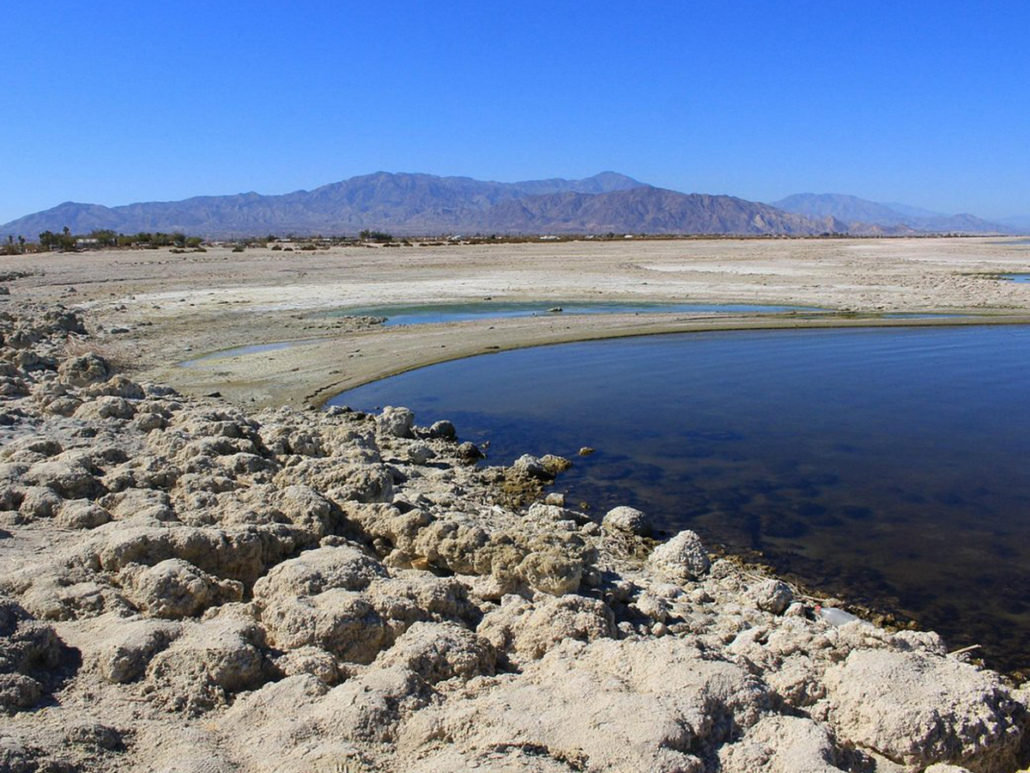
Thriving Salton Sea Communities Project
The Thriving Salton Sea Communities project examines the environmental and public health crisis surrounding California’s Salton Sea, focusing on hydrogen sulfide (H₂S) emissions and their disproportionate impact on nearby low-income, predominantly Indigenous and Latinx communities. While government agencies tend to treat H₂S as a minor odor nuisance, this research—grounded in community-based monitoring—demonstrates that emissions are more frequent and severe than officially reported, and are closely tied to environmental conditions like wind and temperature. Residents experience these emissions as chronic, embodied health burdens linked to respiratory issues, headaches, and broader environmental injustices, compounded by agricultural pollution, shrinking water levels, and inadequate infrastructure. The project reframes H₂S exposure as not just a technical issue, but a matter of environmental justice and lived experience.
Combining scientific data with interviews, focus groups, and creative workshops conducted in partnership with community organizations, the research highlights how pollution shapes both physical health and perceptions of the future, especially among youth who associate the region with decline and limited opportunity. It also critiques “safe threshold” models of pollution, showing how residents experience toxicity as constant and pervasive. In its final phase, the project aims to return knowledge and tools to the community through accessible outputs like a zine, workshops, and advocacy resources, while promoting participatory, community-led research. Ultimately, it seeks to challenge narratives of the Salton Sea as a lost or toxic space and instead support visions of environmental justice and long-term community thriving.
People

Kaily Heitz
Department of Geography
Kaily Heitz is a Black Geographer bridging Black feminist interventions and insights into the lived experience of Blackness, Urban, and Geographic research on the relationship between race, political-economic structures of inequality, and spatial justice. Specifically, Heitz’s work examines the way that Black anti-displacement activist organizations and community-based development groups respond to inequitable city planning by utilizing a cultural framework that represents the experience of place-specific racialization.