
Shelter as Form:
Rebecca Belmore’s Marble Tent
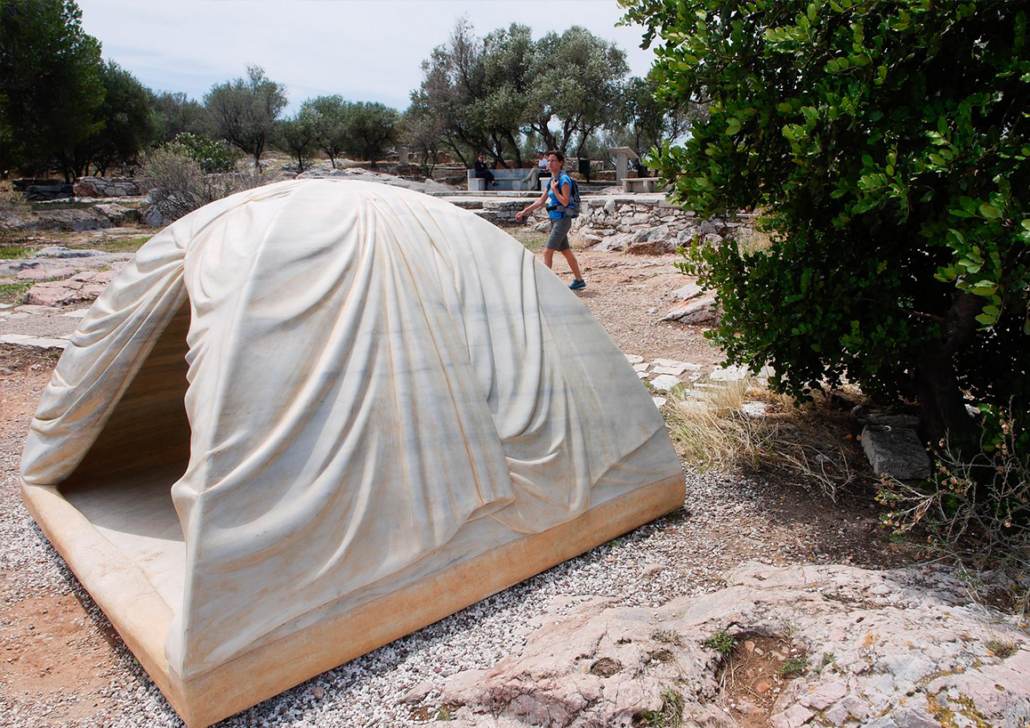
My project takes as its point of departure a marble tent-sculpture by the veteran Canadian artist Rebecca Belmore, made for Documenta 14 in Athens in 2017. Titled Biinjiya’iing Onji (From Inside), the hand-carved work was installed outdoors on a small hilltop park directly facing the Acropolis and the Parthenon. This carefully constructed sightline allowed Belmore — an Anishinaabe artist widely recognized for her three-decade feminist, multidisciplinary, and socially engaged practice — to create a symbolic dialogue between an iconic monument of Western civilization, the erosion of Indigenous sovereignty, and the precarious shelters associated with refugee displacement highly visible in Athens and across the Greek islands at the time.
Belmore’s sculpture forms part of my book-in-progress on contemporary art and postcolonial dispossession — by which I mean the forms of displacement rooted in the historical experiences of colonization and enslavement. The book, Migrant Forms: Contemporary Art, Colonial Pasts, examines how contemporary artists, most of them women, have probed these fraught dynamics and their historical underpinnings through diverse aesthetic strategies and material practices. Each of the four chapters centers on a keyword that galvanizes a broad spectrum of themes around postcolonial migration: the border, baggage, shelter, and the seas.
The chapter on shelter explores how this motif has been taken up by Belmore and other feminist artists engaging with the social injustices of the colonial past. In their work, shelter gestures less toward the masculine realm of architecture than toward the instinctual act of seeking refuge — beneath a tree, inside a cave, within a hut. It embodies an ecological consciousness and a survivalist return to an economics of necessity. Working with organic materials like sand, stone, twigs, and timber, these artists produce uninsulated huts, stone tents, patched sheds, and earthen lodges in lyrical and provocative ways. Evoking displacement and instability on one hand, and resilience and material adaptation on the other, I show how shelter emerges in contemporary art as an ambivalent trope that opens onto pressing ethical and environmental questions about dwelling and being in the material world.
Photo caption: Rebecca Belmore, Biinjiya’iing Onji (From Inside), 2017. Marble tent, Documenta 14, Athens, Greece. Credit: Serge Mouraret/Alamy.
People

Saloni Mathur
Saloni Mathur is currently Professor of Art History at UCLA and was Ford Foundation Scholar-in-Residence at MoMA in New York in 2024/25. Her areas of interest include modern and contemporary South Asian art; migration, diaspora, and postcolonial criticism; decolonization and aesthetics; and museum studies in a global frame. Her most recent book, A Fragile Inheritance: Radical Stakes in Contemporary Indian Art, was published by Duke University Press in 2019 and is available on-line as part of an Open-Access initiative (learn more here).