
Infrastructures of Collaboration: German Film Feminisms
“Feminism” is a problem. Not in and of itself, but the term: “As soon as any radically innovative thought becomes an ism, its specific groundbreaking force diminishes, its historical notoriety increases, and its disciples tend to become more simplistic, more dogmatic, and ultimately more conservative” (Johnson [1980] 2014: 327). This project sustains the vitality of feminist thought by approaching it as inherently plural. Multiple “feminisms,” or diverse approaches to feminist theory and practice, emerge even within small artistic communities. In Germany and Austria, for example, films made collectively by women over the past thirty years have received substantial international recognition on the festival circuit. Many of these filmmakers collaborated on one another’s films as screenwriters and actors, studied together, and co-founded their own production companies. Yet an analysis of the collaborative and infrastructural foundations of this work, without which it could not have emerged in the first place, remains largely absent from existing scholarship.
This lack of comprehensive engagement cannot be attributed to any narrowness in these films’ thematic scope. On the contrary, films by German and Austrian women directors address a wide range of aesthetic, political, and transnational concerns. Many engage directly with questions of gender and social justice within German-speaking societies, while others move beyond national contexts to extend feminist inquiry past representational concerns toward intersecting social, political, and material conditions. Rather than advancing a single feminist agenda, these films pursue markedly different approaches, varying in topic, scale, format, and method. They are shot across France, Italy, Bulgaria on the Greek border, Japan, South Korea, China, the United States, and Spain, often in multiple languages, and their approaches to feminism are anything but homogeneous.
While auteurist approaches have played an important role in making women filmmakers visible within film history, they often risk reproducing individualizing narratives that obscure the collaborative labor and institutional support that sustain filmmaking as an artistic practice. As such, this project moves beyond a focus on individual directors toward feminist film practices as a shared field. By redirecting attention from the film as a supposedly self-contained, single-authored object to the networks, institutional affiliations, and funding structures that enable its production – work that is often dismissed as unglamorous and separate from the “real” creative work – this project reframes infrastructure as a constitutive site of feminist artistic practice aligned with longstanding feminist critiques of invisible and bureaucratic labor.
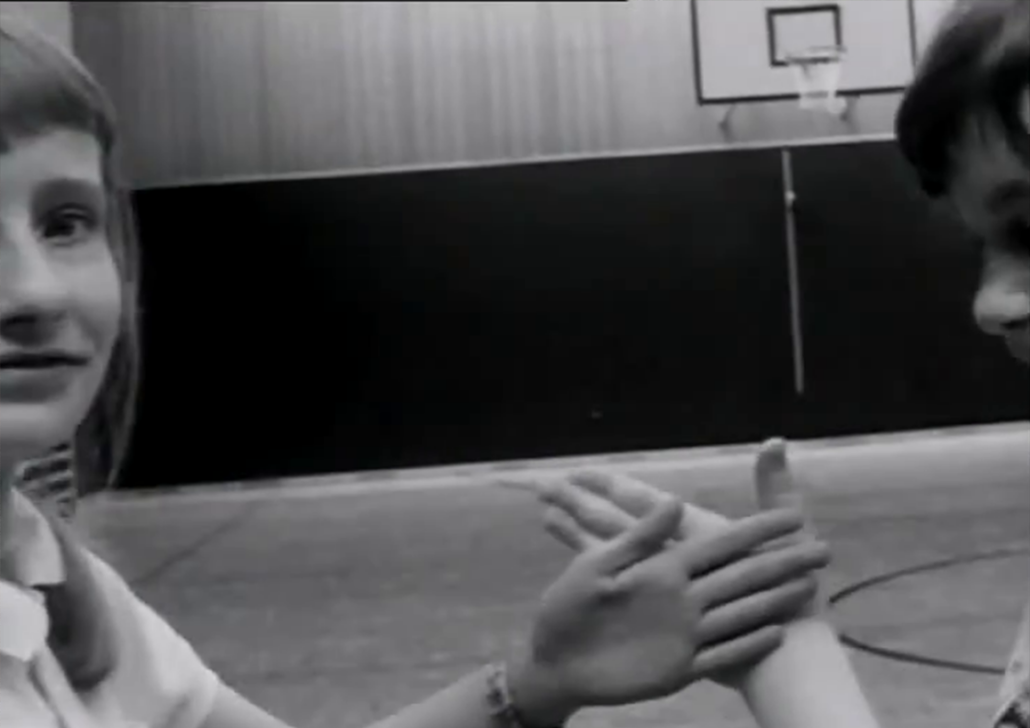
Photo caption: Ägypten (Egypt), 1996, dir. Kathrin Resetarits, asst. dir. Jessica Hausner. Screenshot.
People

Kalani Michell
Kalani Michell is Assistant Professor in the Department of European Languages and Transcultural Studies at UCLA. She has taught and written about a wide range of art, film, and media topics. Her book, Working Title: Media Packaging and the Margins of Art, explores the supposedly mundane things involved in creative work that you’re not supposed to talk about: prerequisites, formalities, long waits, copyright battles, packaging dilemmas, and project pitches (like the one you’re reading now). Media processes typically understood as merely peripheral to a discrete and more valuable “work of art” in the making.